
Have you ever wondered why your salary runs out before the month ends, even though you haven't made any major purchases?
You receive your paycheck, pay your bills, buy groceries, and cover your everyday needs. A few weeks later, you check your bank balance and ask yourself: Where did all my money go?
Sometimes, rising living costs and financial responsibilities leave little room for savings. Other times, small, unplanned expenses add up throughout the month.
Whatever the reason, understanding where your money goes is an important first step toward managing it more effectively. You don't have to be a financial expert to start building better money habits.
Here are five practical ways to manage your spending and make more informed financial decisions.
1. Find Out Where Your Money Goes
It's usually easy to remember major expenses such as rent, electricity, and transportation. But what about the small purchases we make throughout the week?
A coffee, a delivery fee, or an occasional snack may not seem expensive on its own. However, repeated purchases can add up.
If you spend $3 a day on unplanned purchases, that's $90 in a 30-day month or about $1,095 over 365 days if the habit continues.
This doesn't mean every small purchase is unnecessary. The point is to understand how much you spend and decide whether those purchases are worth it to you.
Try this: Track your expenses for 30 days. Write down the amount, date, and spending category for each purchase. At the end of the month, review which categories take up the largest share of your income.
2. Learn to Separate Needs From Wants
One useful financial habit is learning to distinguish between what you need and what you want.
Needs typically include essential expenses such as housing, groceries, utilities, and necessary transportation. Wants might include entertainment, dining out, and purchases that could be delayed without affecting your basic needs.
Before making a nonessential purchase, ask yourself:
- Do I really need this right now?
- Could I wait until next month?
- Is there a less expensive alternative?
- Will this purchase affect an important financial commitment?
These questions are not about denying yourself everything you enjoy. They're about spending with intention.
Spending wisely doesn't mean spending nothing. It means making room for what matters most.
3. Plan Your Spending Before the Month Begins
A more organized approach is to decide how you want to use your income before the month begins.
Start with your expected take-home income. Then list essential expenses, financial commitments, savings goals, and optional spending. Make sure your total planned spending and saving fit within your available income.
If money is tight, focus first on essential expenses and realistic commitments rather than following a budget that doesn't match your circumstances.
Your first budget doesn't need to be perfect. A useful budget is one you can understand, follow, and adjust when life changes.
4. Think Beyond This Month
Monthly budgeting is important, but some expenses don't arrive every month: annual insurance, school costs, vehicle maintenance, family occasions, or irregular bills.
That's why annual budget planning can be helpful. Consider larger expenses you expect over the next 12 months, not only this month's bills.
Suppose you'll need $600 for an annual expense in 12 months. Planning to set aside $50 each month can help you work toward having the money ready.
Unexpected expenses can still happen, but preparing for costs you already know about can reduce financial surprises.
Monthly planning helps you manage today. Annual planning helps you prepare for what's ahead.
5. Review Your Spending and Learn From It
Tracking expenses is helpful, but reviewing what you've recorded is where you start learning from your financial habits.
At the end of each month, compare your planned budget with your actual spending. Ask yourself:
- Did I spend more than expected?
- Which categories were difficult to manage?
- Were there purchases I could have postponed?
- Did I make progress toward my savings goals?
- What should I change next month?
If you exceed your budget, don't treat it as a reason to give up. Perhaps your estimate was too low, or an unexpected expense came up. Use what you've learned to make next month's plan more realistic.
Is Tracking Every Expense Too Much Work?
Recording every purchase in a notebook can feel tedious, especially when you make several transactions throughout the day. Calculating totals and organizing categories manually can also take time.
You can use a notebook, a basic spreadsheet, or a ready-made digital budgeting tool. The best option is the one that fits your needs and that you're comfortable using consistently.
Meet the Annual Budget Planner by The Useful File
At The Useful File, we created the Annual Budget Planner, a reusable Google Sheets template designed to help you organize your money throughout the year.
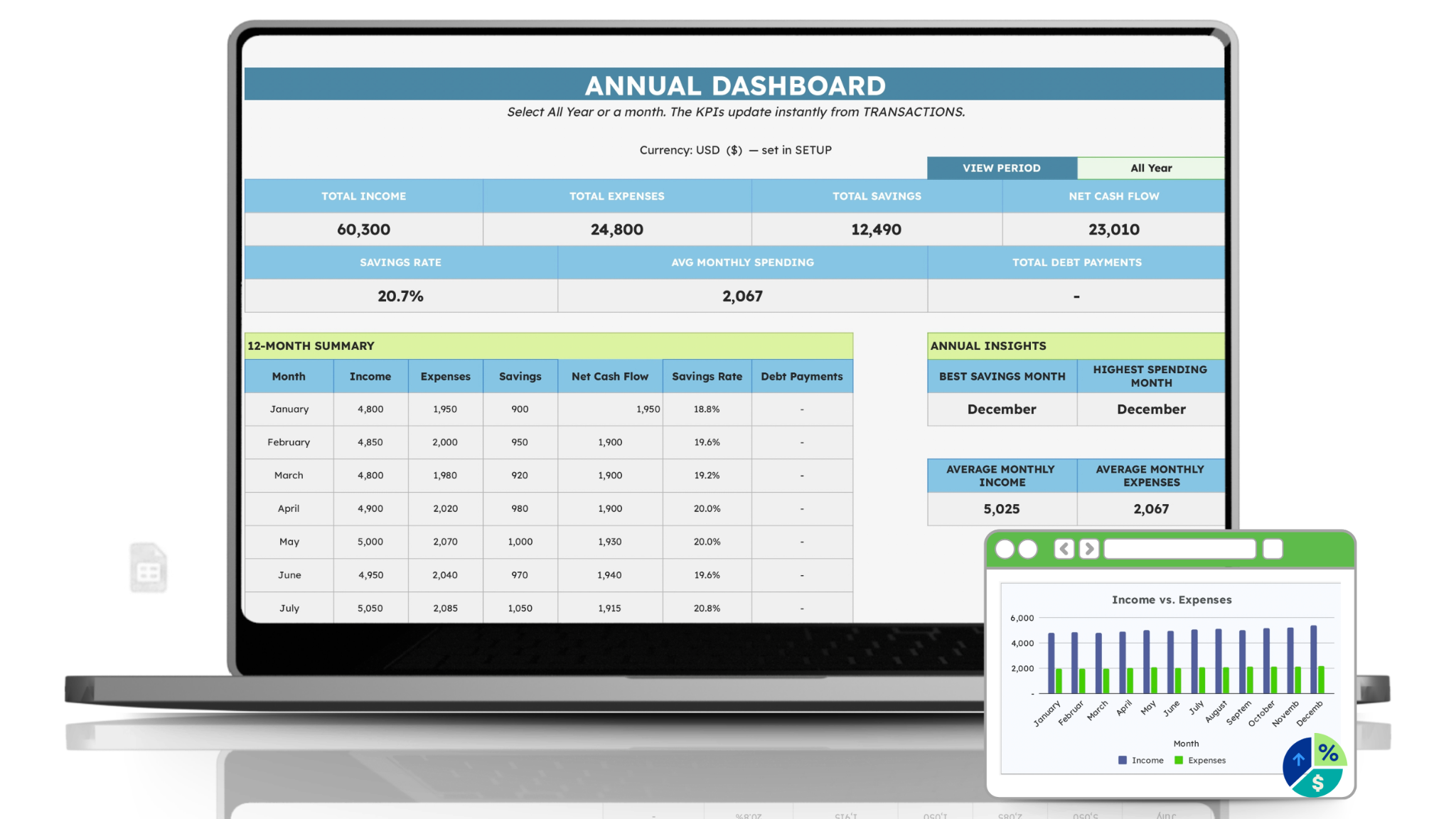
It brings together practical budgeting tools in one file:
- Monthly budgeting: Plan your expected income and spending for each month.
- Transaction tracking: Record income and expenses as they happen.
- Budget comparisons: Compare planned amounts with actual spending.
- Annual overview: Review financial summaries and charts across the year.
- Savings goals and debt tracking: Follow goals and repayment plans.
- 50/30/20 budgeting: Explore an optional guideline for dividing income.
- Net worth tracking: Review assets and liabilities.
Do You Need Google Sheets Experience?
You don't need to build complicated formulas yourself. After purchasing, open the template in Google Sheets, make your own copy, and follow the included instructions. Enter information in the designated areas and use the built-in calculations and summaries to review your finances.
The template doesn't connect automatically to your bank accounts, and you remain responsible for entering and checking your information.
You provide the information. The template helps you organize it and understand the results.
It won't automatically increase your income or guarantee savings, but it can make financial planning and tracking more organized.
Start Small. Build Better Money Habits.
You don't have to change every spending habit overnight. Start by understanding how much money comes in, where it goes, and what you'll need in the months ahead.
Make a plan, track your expenses, and review your progress regularly. You can begin with a notebook and pen—or use a tool that helps keep your financial planning together.
READY TO GET ORGANIZED?
Plan your money in one connected file.
Explore the features and see whether the Annual Budget Planner fits your needs.
Explore the Annual Budget PlannerGeneral educational information, not personalized financial advice.